Using a Reserve Study to Prepare for Major Projects
Roofs, paving, pools, elevators. Every Florida community association faces major projects eventually. A Reserve Study turns them from surprises into scheduled, funded work.
Start with the Plan, Not the Project
If you're a Community Association Manager or have ever served on a community association's Board of Directors in Florida, you already know budgeting comes with a whirlwind of questions:
- What increases in cost are going to be incurred for our annual service contracts?
- Will there be another jump in insurance premiums next year?
- What major projects are due to be completed next year?
- Do we have enough funding to account for all of the above? And if not, how will we accumulate that funding?
While we aren't specialists in annual increases nor rises in insurance premiums, a Reserve Study (the plan) can help determine which major projects are likely to come due and how you may want to approach them.
What is a Reserve Study?
In short, it's a useful source of information as well as a financial guide created for the benefit of the property served.
Expanded, it's a professional analysis of the major physical components your association (or property) is responsible for, what visible condition those components are in, when major projects for those components are due for completion, and how much your reserve fund should accrue along the way to complete those projects.
Homeowner Insights, LLC prepares Reserve Studies under the Reserve Study Standards established and updated by the Community Associations Institute. The work is led by a credentialed Reserve Specialist who cares about providing the highest quality and value to you. We care about providing a sustainable tool that can be used now, and in years to come during future budgeting decisions.
What Counts as a Reserve Project?
Referencing the Reserve Study Standards mentioned above, each component included within a Reserve Study must pass all three parts of the following test:
1. The association has the obligation to maintain or replace the existing element.
In other words, your association should be responsible for maintenance. Anything maintained by unit owners (such as exterior unit windows), a utility company (such as leased street lights), or a government entity (such as public roadway infrastructure) should be excluded from your reserve plan!
2. The need and schedule for this project can be reasonably anticipated.
This speaks to both the longevity of certain components and the limitation in scope of a Reserve Study engagement. Some components will last throughout the foreseeable future, leaving no predictable project to include. Others may be included because the Reserve Study's site visit includes a visual condition assessment only (i.e. no intrusive or invasive testing was conducted) and that assessment wasn't enough to reasonably predict a future project.
3. The total cost for the project is material to the association, can be reasonably estimated, and includes all direct and related costs.
This speaks more to how significant a project cost is to the association. A typical Reserve Study process should establish a clear cost "threshold" for consideration. If a project's estimated cost falls below that threshold, it isn't considered material (substantial) to the association and is thus expected to be included within the Operating budget (not Reserves).
If a component passes all three tests and isn't otherwise a normal Operating budget item, then it should be included in your Reserve Study's component list as a major capital project. Typical examples in Florida communities include:
- Asphalt Repairs, Sealing, and Resurfacing
- Site Fencing, Lighting, and Walls
- Exterior Painting, Sealing, and Waterproofing
- Roof Replacements
- Elevator Modernizations
- HVAC Replacements
- Major Mechanical System Replacements
- Interior Renovations (Fixtures, Flooring, Equipment, Amenities)
- Outdoor Amenity Refurbishment and Replacement Projects (Playgrounds, Pools, Sport Courts)
How a Reserve Study Process Supports Project Planning
Answer #1: Proactive Planning
For each component, the Reserve Study estimates its remaining useful life, which gives readers a clear indication of how much time left before a project needs completed, and pairs that timeline with a current replacement cost estimate. Line those components up on a calendar and the board can see the road ahead instead of reacting to whatever breaks next.
In addition, a quality Reserve Study provider often will include additional, useful context for projects based on their current industry knowledge and experience.
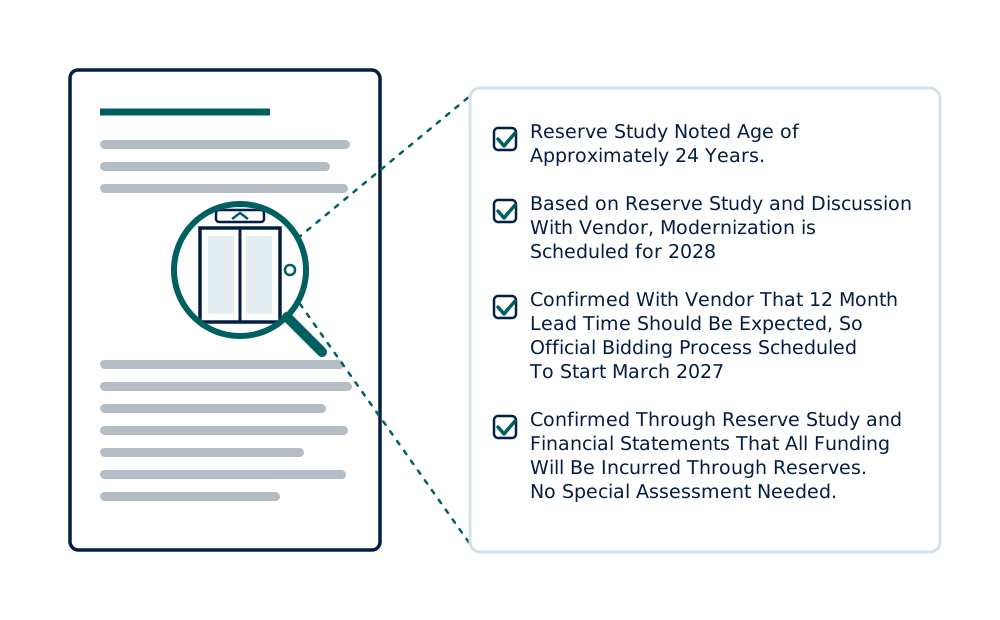
Example: The elevator industry can report a 6 to 12-month lead time for modernization projects. If that knowledge goes unreported and the Board decides to start the conversation after the clock hits zero, there could be consequences. Elevator parts may not be available so downtime would mean all residents/guests solely have to use the stairs. Immediate "rush" orders could come at an exponentially higher cost than those generated proactively.
In practical terms, a current Reserve Study lets your board answer four questions directly:
- What major projects are ahead over the next five, ten, twenty, thirty years?
- When should the association/property be financially capable of completing each of those projects?
- How much money should be collected to sustainably complete all anticipated projects?
- Is the current reserve funding level adequate or inadequate to accommodate future major projects?
When the answer to that last question is no, it is far better to learn that early. There will still be time to adjust funding and prepare proactively for projects. The more you can minimize "reactive" measures, the better off you will be in project planning and completion.
Answer #2: Project Prioritization
This wasn't listed in the "direct" four-question list above intentionally. Reserve Studies aren't always guaranteed to state which projects should be completed first, mainly because that isn't always a decision that should be made by the Reserve Study provider. However, we are always happy to give more direct guidance on "What should we do first?" within any follow up conversations that arise. As a general rule of thumb, we recommend prioritization of projects in the following order (even if not explicitly listed in the Reserve Study's component list):
1. Projects Related to Any Safety and Legal Obligations
This can be anything from required restoration projects brought on by a Milestone Inspection, to necessary replacement of railings due to wide picket spacing, to items related to compliance (one relevant example was installation of Door Lock Monitoring (DLM) equipment in elevator systems by January 1, 2024).
2. Projects That, If Not Completed, Could Create or Accelerate Damage (Additional Cost)
This often revolves around exterior projects, such as roof replacements, painting, and exterior waterproofing. If those projects aren't completed within a reasonable timeframe, then the consequence could be more significant restoration needs due to the inadequate protection of the building structure. Asphalt resurfacing is another good example, as delays can cause exposure to the systems base/subbase and cause a potential need for reconstruction (exponentially higher cost than resurfacing itself).
3. Projects That Are Functionally Necessary and, If Not Completed, Would Cause Disruption to Residents
Bumpy elevator rides, hot interior temperatures due to malfunctioning HVAC equipment, or continuously faulty access systems. All of the above would cause increased frustration for homeowners.
After #3, the conversation often becomes more situational and specific to each property. This is often related to two areas: aesthetics (interiors) and amenities (levels of use and care by residents). Do the residents see interior remodeling as more important than new pool furniture? Or are the sport courts to be prioritized because they're the most used amenity within the development? When several projects compete for the same funds, aesthetics may be the first thing visible to residents. However, it should often be lower in prioritization.
The Cost of "Reactive" Approaches and Waiting Until Failure
When a component fails without appropriate planning, the subsequent project happens on the worst possible terms. Emergency contractor pricing replaces (and dwarfs) competitive bids, materials get expedited at a premium, and residents live with disrupted service while the work is rushed. Deferral of projects will also tend to cascade the issue, since a failed roof past its serviceable life can expose the structural items and finishes beneath it.
The financial fallback in these situations is usually a special assessment, a one-time charge to owners on top of their regular assessments, or a loan the community repays with interest. Both are harder conversations than a steady, justified funding plan sustained over many years.
In coastal markets like Sarasota and Naples, where both salt air and extreme UV exposure advance wear to exterior components on beachfront condominiums and developments alike, an up-to-date reserve schedule is especially valuable.
Conclusion
In our experience, major projects go well when the board saw them coming years earlier, funded them a little at a time, and prepared for the work on a proactive timeline. A current Reserve Study is a form of useful information that promotes such an approach, and it is one of the clearest signals to owners that their community is being led with care.
What do we mean by current?
A Reserve Study completed within the past three years. A Reserve Study is a snapshot, and the world it describes keeps moving. Labor rates, material prices, insurance conditions, and supply chains all shift. An outdated study can quietly understate what your next project will cost. The Reserve Study Standards' recommended practice is that a Reserve Study be completed (or updated) once every three years. An update is also worth considering more immediately if conditions in your community change significantly (for Florida, that can be after a hurricane strikes).
A Reserve Study helps the association determine funding needs for future projects on a gradual basis. Even when the above factors change, a reasonable action plan can be created on the funding side through a Reserve Study update. This keeps annual budgets predictable, spreads the cost fairly across the owners who use the components over time, lowers the likelihood for special assessment needs, and gives owners confidence that the association is setting their assessments through a founded plan.
This article is intended to be educational and is not professional legal or project management advice; Consult your association's attorney about how Florida statutes apply to your community. Consult your association's servicing vendors with any questions related to potential safety concerns, code obligations, or insurance requirements.
Turn the reading into your community's numbers
General answers only go so far. A scoped proposal applies them to the property your board actually manages.
Any statute references on this website were last reviewed on September 12th, 2026. Laws change, and no information on this website is intended as a legal opinion. Please verify current legislative requirements with your association attorney.